The Commercial Properties Most Crews Never Think to Bid
July 12, 2026
Updated July 12, 2026
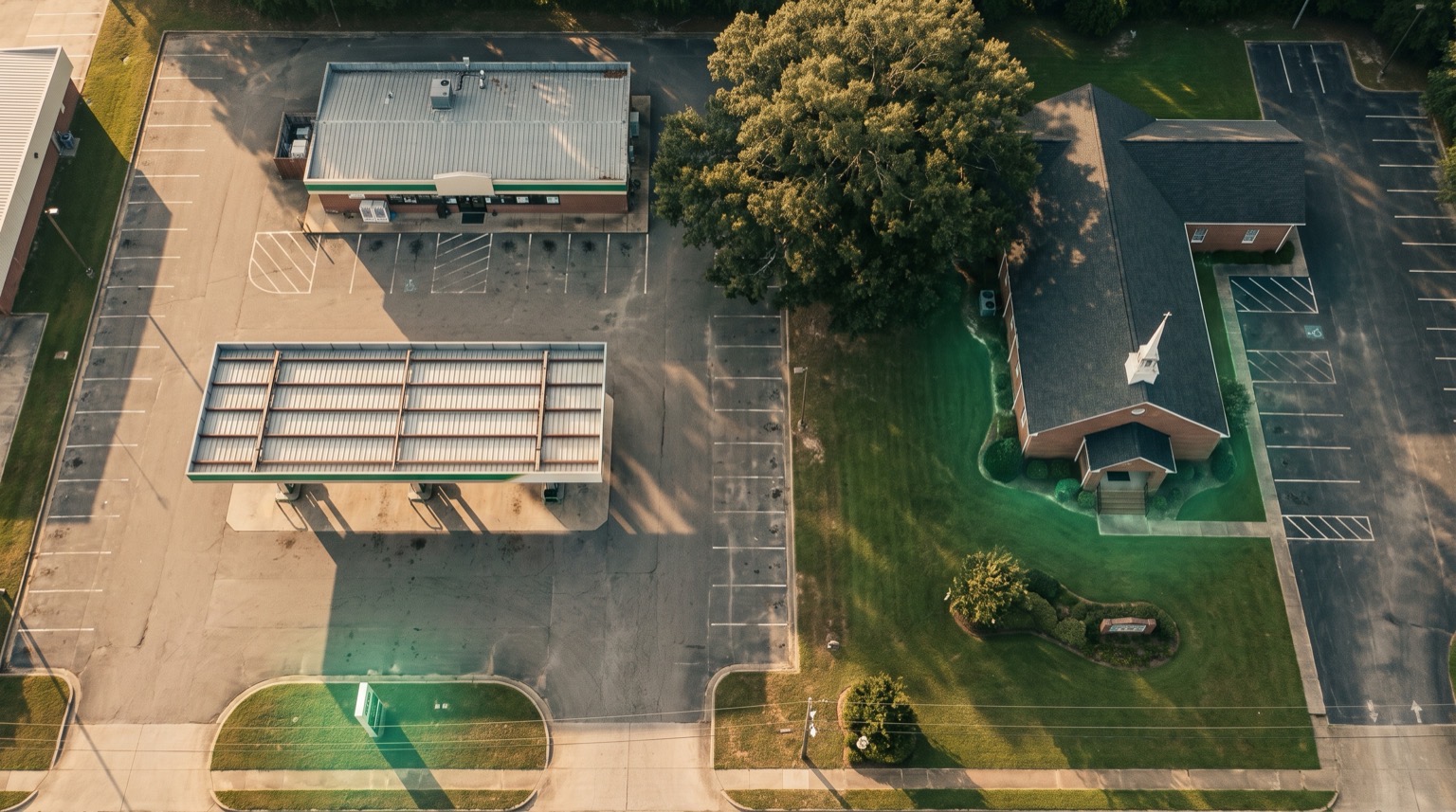
Seeing the territory does not mean seeing all of it. Most crews build their commercial target list around the same three categories, and stop there.
Ask any landscaping crew to name commercial property types and the answer comes fast: HOAs, apartment complexes, office parks. Ask a second time and you might get shopping centers or retail strips. Rarely does anyone mention a truck stop, a gas station, a cemetery, or a church. That is not because those properties do not need service. It is because nobody is looking at them.
The obvious tier is already crowded
The properties every crew names first are also the properties every crew is already bidding on. HOAs get the most attention because they are visible and recurring. Apartments and office parks come next because the buying path is more familiar to describe: a property manager, a facilities contact, an RFP cycle crews have seen before, even when actually reaching that person still takes real work.
That visibility is also the problem. When every operator in a market defaults to the same short list, those properties become the ones where "cheapest bid wins" complaints cluster hardest. You are not finding an edge by bidding where everyone else already bids. You are joining a line.
The properties that rarely make the list
None of the property types below are secret. They are just skipped, because they do not look like a landscaping account until someone actually stops to ask.
Truck stops and gas stations. These sites need mowing and bed maintenance like anything else, but they rarely show up on a landscaper's outreach list because they do not read as a "commercial account" the way an office park does. The tradeoff is real: soil at fuel-adjacent sites is often compacted or contaminated, and plantings can fail at a higher rate than a typical commercial bed. Crews who work these sites price in a contingency for replacement rather than assuming a clean install.
Cemeteries. Grounds maintenance at a cemetery is a real, recurring, and often underserved need, especially at smaller or older sites without an in-house crew. The work is different in character (mowing around headstones, no room for wide equipment in older sections) but the underlying service is the same maintenance contract every other commercial property needs.
Churches and religious campuses. These sites are frequently large enough to justify a real maintenance contract, and the decision path runs through a church office or facilities coordinator rather than a corporate property manager. That different path is exactly why they get skipped by outreach built around property-management directories.
Municipal and park-board sites. These run through a formal, public bid process rather than a phone call or a drop-in, which is a different motion entirely. Worth knowing about specifically because it means the entry point is a public RFP portal, not a cold visit.
Why this tier gets skipped
There is a pattern underneath all four categories, and it is not that the work is bad. It is that none of them look like the properties everyone already knows how to prospect.
Property managers are the default channel most crews already have some mental model for: one relationship, multiple properties, a buying process that at least has a name, even when getting past the gatekeeper to the actual signer is its own separate fight. Truck stops, cemeteries, and churches do not come with even that starting shortcut. Each one has its own decision-maker, often a single owner, a facilities coordinator, or a volunteer board, not a portfolio manager juggling twenty properties. Finding that specific person takes more digging than looking up a management company.
That is also the honest caveat here: this is a genuine pattern in how crews describe their target lists, not a guaranteed pipeline of easy wins. Some of these properties will be too small to be worth the drive. Some will already have a longstanding vendor with no reason to switch. The point is not that every gas station is a hidden goldmine. The point is that this tier gets almost no attention, while the obvious tier gets nearly all of it.
What actually makes one of these worth pursuing
The same qualification logic that applies to any commercial property worth bidding still applies here. Route fit still matters. Maintainable green area still matters. A cemetery two hours outside your service area is not suddenly worth the drive just because it is overlooked.
What changes is the search. If your prospecting only covers property-management directories and drive-bys through office parks, you will never even see these properties as options. Seeing the territory has to include the sites that do not read as "commercial" at first glance, not just the ones that obviously do.
Finding the actual signer is the harder part here, not the easier one
This is where the non-obvious tier gets harder, not easier, than HOAs and office parks. Finding the real signer at a listed office park or a professionally managed HOA is already a genuinely hard problem on its own. At a church campus, a cemetery, or a single-owner gas station, there is often no management company or directory to even start from. The decision-maker might be a facilities coordinator who also handles the building, a single owner who is hard to reach during business hours, or a volunteer board member with no public contact page at all.
That is not a reason to skip the tier. It is the reason these properties stay underbid in the first place: most crews have no way to resolve who actually signs at a property with no visible management structure at all. Reaching that person before wasting a trip on a guess is a harder version of a problem that is already hard everywhere else, and it has to be solved before outreach, not during it.
Even once you find that person, timing still decides whether the conversation goes anywhere. A church campus or cemetery that just renewed its vendor is not a dead end forever, just not this month.
Start where the work already fits
If you already have room on the route near a truck stop, gas station, cemetery, or church campus, that proximity is worth more than chasing a farther-away office park just because it looks more familiar. The obvious tier will always get more attention. The overlooked tier is worth a second look precisely because it does not.
Compare that against HOAs, apartment complexes, and office parks if you are still deciding where most of your effort should go. Most crews should still build their core pipeline on the obvious tier. This one is worth adding at the edges, not replacing the core with.
If you want to see which of these overlooked property types actually sit inside your service area, and who signs for them, map your territory and see what shows up outside the usual three categories.